Conjunction (Basic ㊦ 231)
In front of or before some situation comes about.
Equivalent: Before; in front of
| (i) Vinformal nonpast | 前に | |
| 話す前に | Before someone talks/talked | |
| 食べる前に | Before someone eats/ate | |
| (ii) Noun | の前に | |
| 朝ご飯の前に | Before breakfast |
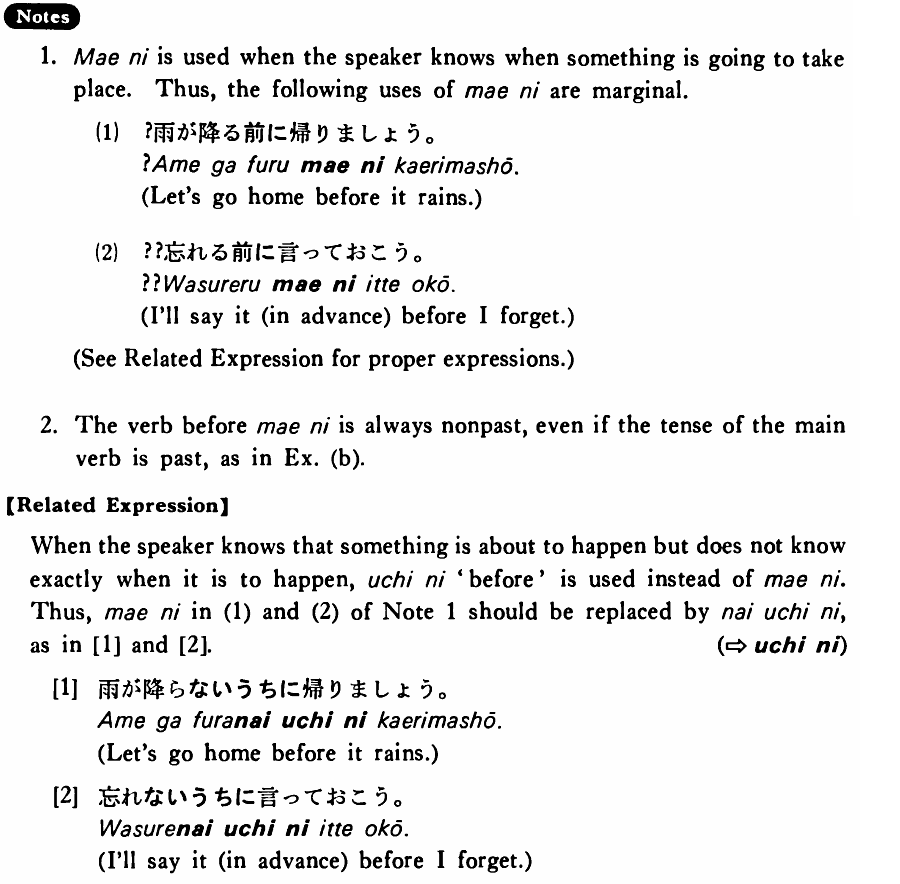
1. 前に is used when the speaker knows when something is going to take place. Thus, the following uses of 前に are marginal.
2. The verb before 前に is always nonpast, even if the tense of the main verb is past, as in Example (b).
【Related Expression】
When the speaker knows that something is about to happen but does not know exactly when it is to happen, うちに 'before' is used instead of 前に. Thus, 前に in (1) and (2) of Note 1 should be replaced by ないうちに, as in [1] and [2].
(⇨ うちに)
[I]
[2]